Aram Zucker-Scharff is an Engineering Lead for Privacy & Security Compliance. Aram has developed open-source tools for publishers and consulted on content strategy and digital newsroom workflows.
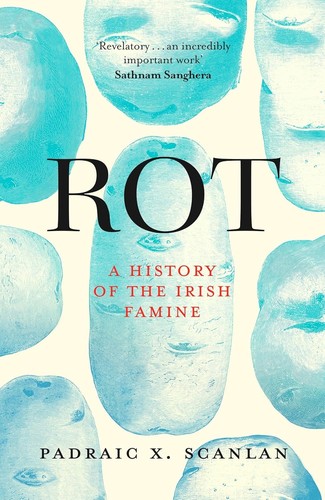
In the 1800s, as Britain became the world's most powerful industrial empire, Ireland starved. The …
Rot is a must-read book. It is a book about one thing--the Irish potato famine--but also a lot of other things that this continuing event illustrates with a lot of relevance to today.
Rot is a book about the socially constructed nature of capitalism and markets and how that begun. It is about the UK's decision to enact capitalist markets and their attachment of moral authority to performance of a very specific type in those markets. The author covers how wide an impact this market creation had, and how the Irish poor were actually quite knowledgable and active in their performance for that market, even while British officials actively spoke about how their starvation would force them out of a false image of backwardness. It covers how the market failed and continued to fail, and how it was forced into being anyway, at great human cost. There is no …
Rot is a must-read book. It is a book about one thing--the Irish potato famine--but also a lot of other things that this continuing event illustrates with a lot of relevance to today.
Rot is a book about the socially constructed nature of capitalism and markets and how that begun. It is about the UK's decision to enact capitalist markets and their attachment of moral authority to performance of a very specific type in those markets. The author covers how wide an impact this market creation had, and how the Irish poor were actually quite knowledgable and active in their performance for that market, even while British officials actively spoke about how their starvation would force them out of a false image of backwardness. It covers how the market failed and continued to fail, and how it was forced into being anyway, at great human cost. There is no invisible hand, there's only power and those people who have decided that power and money is an intrinsic source of virtue... and it turns out those people are wrong. Being rich and in charge didn't give them the solution or make them more good than anyone else. A lot of people died to allow them to pretend that was the case.
Rot is also a book about a number of times that proved countries playing at economic austerity accomplish nothing other than destroying human lives. Austerity has not gone away and every time it comes with the exact same argument that the British applied to the Irish Famine: poorness is moral failure, we must tighten our belts and work harder, helping people survive actually hurts them because it makes them less likely to work and support themselves. In Rot we see one of the very first times this argument was constructed, out of whole-cloth bullshit then with nothing to support it, exactly the same as we heard it yesterday and exactly the same as we'll hear it tomorrow. The austerity argument comes out of the same market morality that the invisible hand does - that the market decides virtue and it is more important to keep it running than it is to save tens, hundreds, or millions of lives. It is illustrated by Scanlan in this book as a horrific ungrounded argument assumed by people who treat the market with the same religious mindlessness that they treated god-kings. It is a work that illustrates the immense, heartless, and pointless human cost. Austerity and market morality cannot stop a disease. The market cannot understand these human lives and it cannot understand their value. All it does under austerity is kill, without any particular control or result. At best, it might kill or chase off enough people to make your market smaller and able to restart again. At worst, it puts countries on the road to an endless phantom recovery that never really takes hold.
Finally Rot is a book about colonialism and the it's costs. It is about how the wages of war, slavery, and de-personhood start at home and boomerang back. It is a story of Ireland, the colony that was told it was part of a Union and treated even worse than a colony as a result. The book goes into great detail about how the Irish were subjected to the colonial techniques the Empire re-ran elsewhere in the outer colonies, the division they sowed, the land they stole, the works of culture, community and art they destroyed. It shows how the work of colonization was inherently destructive and how the Irish, as colonial subjects, were torn apart from their each other, their homes, their livelihoods, and finally--in massive numbers--their lives. All while the British spoke to them about the morality of work and understood nothing of what their work was.
I cannot recommend this book more. You should read it.
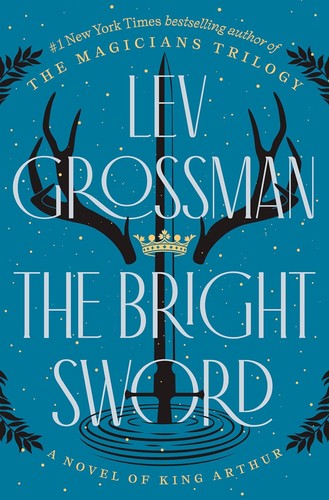
A really great book. A wonderful take on the classic tales and an excellent continuation of them. It is a throughly modern story in a way that updates King Arthur and the Round Table's form to make it more intriguing, insightful and relevant to our current time while it also grows the legend's soul, in the way that only the best Arthurian tales can.
One of the easiest books to read about algorithms you'll find, chock full of insights about how music, the music industry and the world of streaming works. Perhaps the best part is that the casual fun writing is shot through with the author's music suggestions and humanity, giving the whole piece a warm friendly feel. It's also filled with potent quotes about the future we should want to build with algorithms, computers, and art. Every Spotify user should read it. Then everyone else.
Palo Alto’s weather is temperate, its people are educated and enterprising, its corporations are spiritually and materially ambitious and demonstrably …